We'll start with some good news.
Since late last year, we have worked alongside 8 teams through a full AI SDLC transformation, and 6 of them now run entirely on the new setup. Three teams are still in the middle of it.
A few months ago we wrote "AI coding in teams: three patterns we keep seeing," about how individuals getting faster with AI doesn't mean the team is ready to get faster together. This is the follow-up: what it actually takes once a team really does start speeding up together.
The numbers so far
- 8 teams taken through a full AI SDLC transformation, 6 of them fully live
- 3 more teams still in progress
- 30+ running product lines moved onto the new process
- Roughly 3,000+ commits along the way
- 157 rounds of adjustment for the team that iterated the most
157 sounds like a lot. But it is an honest reflection of one thing: no team got it right in a single pass.
We were switching live products, not just tools
None of those 30+ product lines were new experimental projects. All of them were products already in operation.
That meant the process had to change while the products kept shipping. We couldn't stop and start over, and we couldn't wait until everything was figured out before getting started.
So most of those 3,000+ commits weren't about "adopting AI." They were about moving the process over bit by bit: which step to switch first, which step still needs a person to sign off, which rules need to be added, and which practices simply don't work for a particular team and need another approach.
Every adjustment was an answer to the questions raised in that earlier piece: what can be handed to AI, which calls still need a human, and, when something goes wrong, whether we can trace it back to the decision that caused it.
Only 3 companies actually use Teams
We want to be upfront about this.
In the earlier piece, we mentioned that we built our own agent framework, called Teams. But of all these teams, only 3 companies actually use it.
The reason is simple. Teams works best for small teams, roughly the size of a group running 4 to 5 products at once.
The clients we worked with later on had more development teams and more internal product lines. For organizations like that, dropping in a framework designed for small teams isn't necessarily the right answer. So the work we do changed too.
What our work actually looks like
It comes down to two things.
First, we help build the framework. Rather than transplanting Teams as-is, we build a setup that fits each organization's teams and product lines.
Second, we work alongside the teams as they take each project live and adjust it. Getting the framework in place is only the beginning. What really takes time is correcting course, again and again, once each project is actually running.
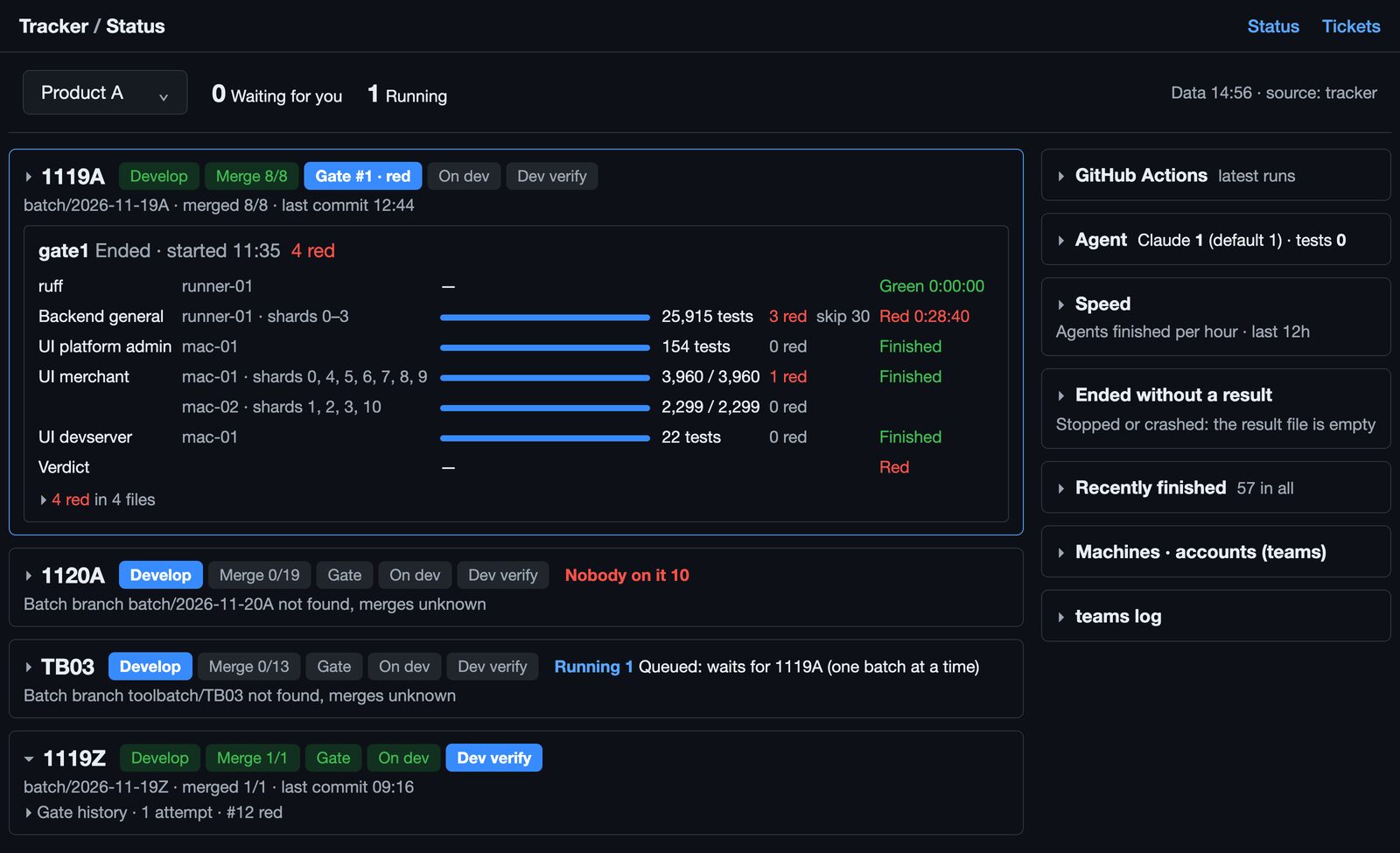
Looking back, this bears out what we have believed all along: frameworks and tools will keep changing, but what makes a team stable is whether collaboration, accountability and judgment have been put back in the right places. A framework is just the container for those things, and it only holds up if it fits.
Where engineers are heading in the new process
Finally, a few words about engineers.
Working alongside these teams, we have watched the place people occupy in the process keep shifting.
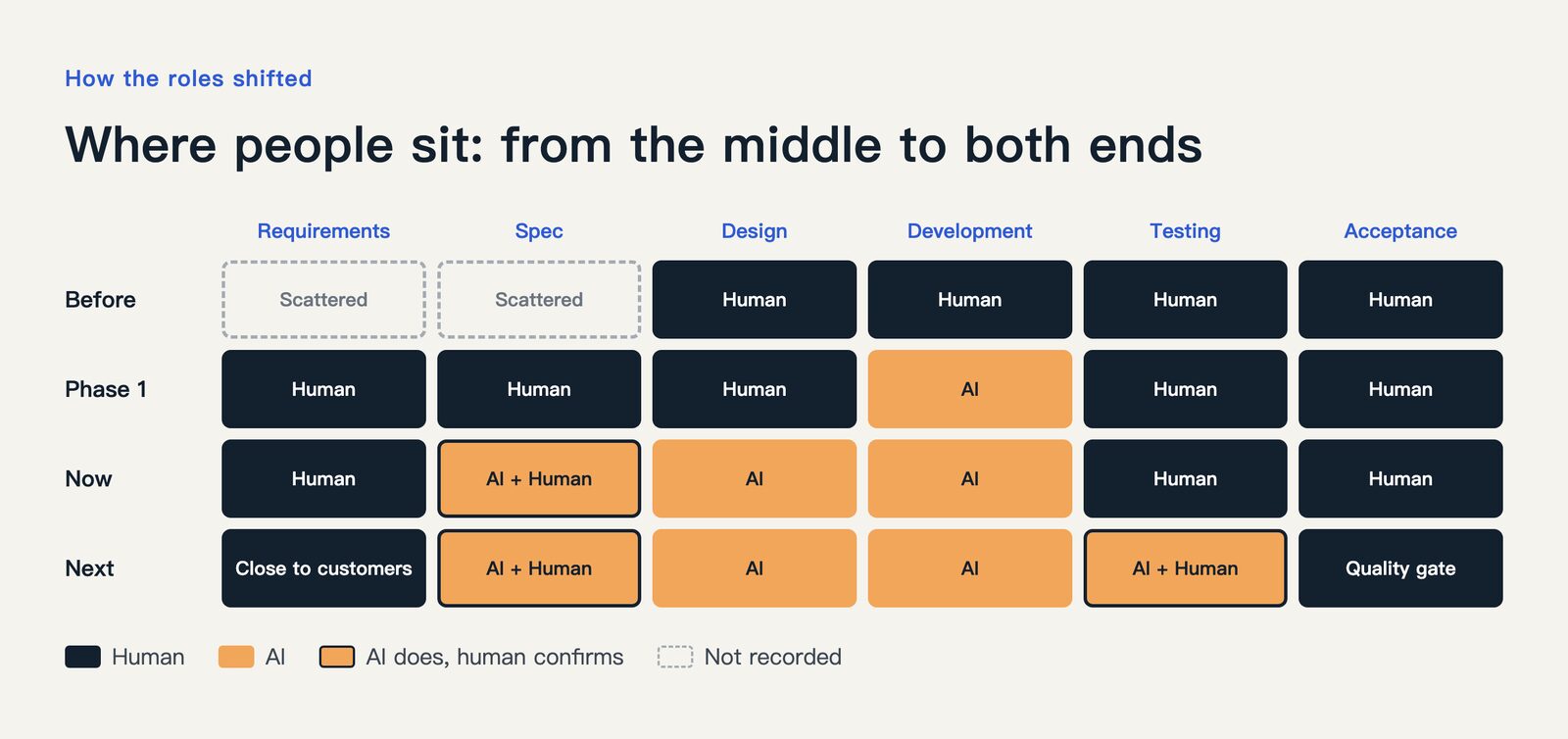
In the past, requirements and specs were often scattered and never properly written down, and engineers spent most of their time in the middle: design and development, and on through testing and acceptance.
In the first phase, AI took over development. For AI to be able to do that work, people started writing requirements and specs down clearly.
Today, design and development are mostly handed to AI, and specs are drafted by AI and confirmed by people. Testing and acceptance are still owned by people.
Next, testing will go the same way: AI will do it and people will confirm the results. People's place will move to the two ends of the process, staying close to customers at the front and guarding quality at the back.
For engineers, that means the center of gravity of the job may gradually shift away from "building the thing" toward two other things: understanding customers and the problem well enough to define clearly what should be built, and judging whether what got built is good enough to ship.
Writing code won't disappear, but it is no longer where most of an engineer's value lies.
Closing thoughts
Six teams fully live is a milestone worth celebrating.
Thank you to these teams for being willing to move their process over, bit by bit, while their products kept running. For the 3 teams still in progress, we'll keep working alongside them until they get there too.
Individuals being good with AI matters. But for a team to become genuinely steadier and faster because of AI, what it takes isn't one impressive rollout. It's a willingness to keep iterating together until it's right.